






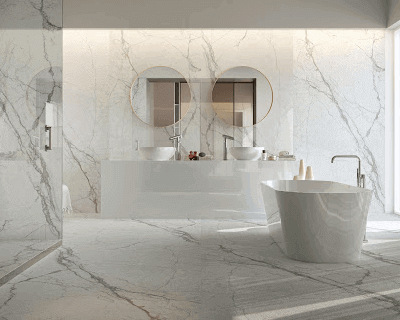
Choosing tiles for a small bathroom can seem straightforward, but it has a real impact on how the finished space feels. The wrong size can make a compact room feel smaller and more fragmented. The right choice, paired with the correct layout and colour, can make it feel considerably more open.
The best tile size for small bathroom layouts depends on the room’s proportions, the surface being tiled, and how much visual complexity you want. This guide covers the key decisions.
Tile size affects how the eye reads a space. More tiles mean more grout lines, and more grout lines mean more visual interruption.
In a small room, this arrangement creates a fragmented effect that draws the eye to the room’s edges. Conversely, fewer, larger tiles let the eye travel farther before stopping, creating the impression of more space.
Large-format tiles, typically 600×600 mm and above, work well in small bathrooms because they reduce grout lines. Less visual noise makes walls and floors appear longer than they are.
Practically, large tiles need a flat, well-prepared substrate. On walls, they are heavier and require the correct adhesive. They also generate more waste on irregular layouts. For shower floors, very large tiles may not accommodate the required fall to the drain.
Dense grout lines from small tiles make a small bathroom feel busier and more confined. That said, mosaics have genuine applications. On shower floors, they handle the slope to the drain without complex cuts. When used as a feature strip or accent against larger field tiles, they add texture without overwhelming the space.
More tiles mean more grout, and grout in a wet environment needs regular maintenance. Dense grout lines in a shower create more surface area for mould if they are not sealed properly.
Larger tiles with narrow joints significantly reduce mould risk. Light-coloured grout also holds its appearance longer than dark grout in high-traffic wet areas.
Layout matters as much as size. A diagonal line draws the eye to the longest dimension rather than the shorter one. Herringbone and chevron patterns work the same way, directing the eye along the room’s length and creating a sense of movement.
A brick bond or offset lay achieves a quieter version of the same effect. It breaks up the grid pattern that would otherwise emphasise the room’s limited dimensions and suits subway-style rectangular tiles particularly well.
Floors and walls have different practical requirements, so the right tile size differs between the two.
| Surface | Recommended Size | Notes |
|---|---|---|
| Bathroom floor | 300×300 mm to 600×600 mm | Allows adequate fall to drain |
| Shower floor | 100×100 mm mosaic | Handles slope without complex cuts |
| Walls (general) | 300×600 mm or 600×600 mm | Fewer grout lines, cleaner result |
| Feature wall | Any format | Works well against neutral field tiles |
Light colours reflect more light, making the space feel more open. Whites, soft greys, pale stone tones, and warm creams all perform well. Glossy finishes amplify this effect by bouncing light further around the space.
Dark tiles can work on floors, adding depth without closing the room in. Contrasting grout creates definition but emphasises each joint, which can draw more attention to the room’s boundaries in a small space.
Avoid these common errors that affect both the look and longevity of the finished result:
For damaged or incorrectly laid tiles, bathroom tile repair and replacement services in Auckland can assess and resolve the problem before it worsens.
A 300x300 mm to 600x600 mm tile suits most small bathroom floors. This reduces grout lines without creating excessive cut waste at the edges. For shower floors specifically, smaller tiles or mosaics around 100x100 mm better accommodate the required fall to the drain.
Yes. Grout that closely matches the tile colour makes the surface appear continuous, making the room look larger. Contrasting grout highlights individual tiles and joints. In a small bathroom, matched or near-matched grout is usually the better choice.
When you hire Honest Tiling for your next tiling and waterproofing job, you can be assured that you will be getting the very best finish completed to an industry standard. Why? Because we have access to reliable suppliers who stock industry-grade waterproofing membranes that can expand and compress without losing their properties, helping your buildings stay dry in all weather conditions.
This is all done by a hardworking and experienced family team that will provide the result quickly and without any hidden costs or budget blowouts. We work dedicatedly to consistently achieve premium quality and high finish. Connect with our experts for a free estimate.
Copyright © 2025 Honest Tiling. All Rights Reserved.. Terms & Conditions